Family patterns are hard to see across multiple child-welfare cases when relationships, events and sources are scattered across records written at different times. Inconsistent labels and outdated care arrangements make comparison harder. Genograms can bring selected connections into view, but each apparent pattern still needs checking against the evidence and context of the individual case.
This guide focuses on reviewing information across a caseload without losing each family’s circumstances. For the wider documentation workflow, see genograms for child welfare case management.
Which Review Do You Mean?
| Review scope | Permitted output to prepare | Boundary |
|---|---|---|
| One family over time | A dated family map with linked source questions | Do not turn a recurring event into a risk score |
| Verified connections across records | Separate case maps and a source-checked relationship note | Confirm identity, purpose, and authorization before linking records |
| Unrelated families for team learning | An approved fictional or appropriately de-identified comparison worksheet | Do not combine identifiable families or imply an automatic caseload search |
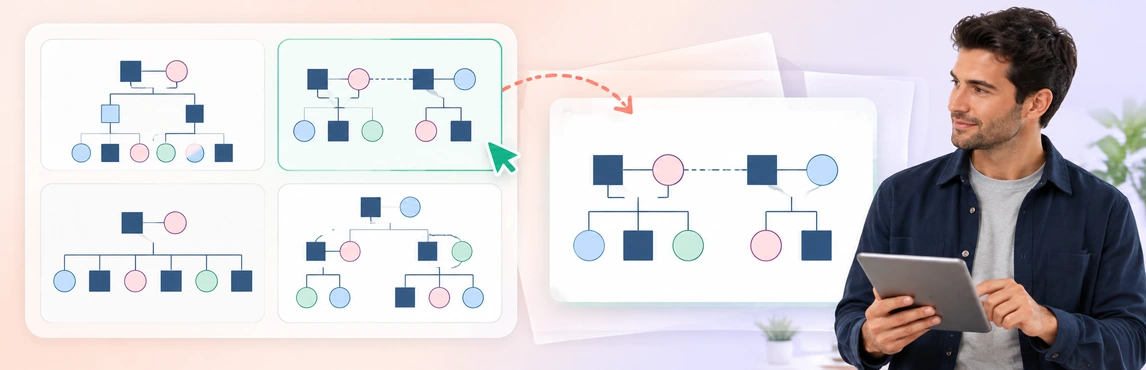
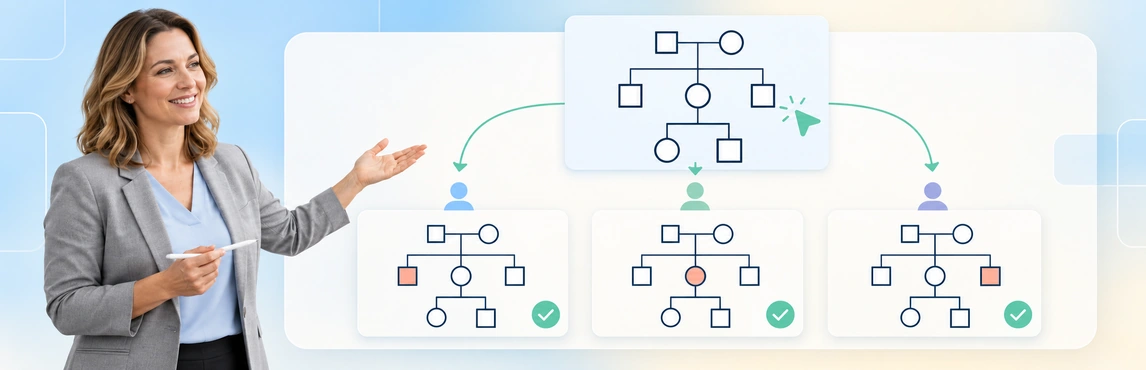
The illustrations on this page depict a fictional, human-led comparison exercise, not automated matching between cases.
Why Similar Case Notes Can Hide Different Relationships
A note such as “staying with aunt” leaves several questions open: who is the aunt, whose account is this, when did the arrangement begin, and is it still current? Across several files, the same phrase can describe very different situations.
| Documentation problem | What becomes difficult to see | Review question |
|---|---|---|
| Different names or labels for one person | Whether records refer to the same connection | What authorized source confirms identity and relationship? |
| Events without dates | The order of changes | Is the date known, approximate or missing? |
| Care arrangements mixed with family ties | Who provides current care versus who is related | Which relationship or arrangement does the line represent? |
| Repeated text copied into later records | Whether an account has been checked again | What is the original source and last review date? |
| Different symbols across workers | Whether diagrams use a label in the same way | What does each legend say? |
| Concerns recorded without supports | The people and resources relevant to the family | Whose perspective and support connections are missing? |
The Child Safeguarding Practice Review Panel’s 2022/23 annual report, paragraph 6.9, describes cases where information about adults around a child was partial or inaccurate. It identifies genograms and chronologies as tools that could have helped establish relationships and the broader picture in those cases. This retrospective observation does not demonstrate that software improves outcomes. Source: Child Safeguarding Practice Review Panel.
The practical task is to reconcile the information, not simply draw every detail. Use this family overview to practice distinguishing confirmed connections from questions that still need a source.


A comparable layout makes questions easier to discuss; it does not make the cases equivalent. A blended household, foster placement or history of separation is not itself a finding about safety or family functioning.
The Multiple Marriages Genogram below can help clarify partner, sibling and step relationships. Adapt the layout to the documented family structure and check identities before linking records; a shared surname or a similar diagram is insufficient.

Keep Current Care, Family Ties and History Distinct
One diagram can accidentally show several historical arrangements as if they all apply today. Before comparing maps, establish the date each represents and distinguish current care from earlier placements or proposals.
Check four details:
- Family relationship: biological, adoptive, step or other documented connection.
- Care arrangement: who provides care now, with its source and date.
- Earlier arrangements: relevant history that should not look current.
- Proposed changes: discussions or plans that have not yet taken effect.
Victoria’s Child Protection Manual identifies several purposes of case recording, including making historical information retrievable, explaining decision rationale and helping identify patterns in behaviour and service responses. This supports keeping the diagram connected to its underlying records, rather than asking a map to carry the full case history. Source: Victoria Child Protection Manual, Case recording.
Use the Foster-to-Adopt System Genogram to practice separating care arrangements from family ties. The template name does not establish adoption as the goal for a particular child; replace the sample details with the current documented context.

Review Recurring Concerns Alongside Support and Context
Family patterns become misleading when the review selects only the details that fit an early explanation. A repeated concern should prompt a source check and consideration of alternatives, including the family’s account and the service response.
For each apparent recurrence, ask:
- What exactly repeats: an event, a label, a person’s account or copied wording?
- Are the sources independent, or do several notes refer back to one account?
- What changed between the events, including available services or practical support?
- What information contradicts the initial interpretation?
- Whose perspective is absent, including the child’s?
- What remains unknown, and who will follow it up?
Do not treat poverty, disability, ethnicity or family structure as proof of harm. Keep reported concerns, observed information and documented findings distinct. The sensitive genogram documentation guide covers attribution and audience-specific handling; the trauma-mapping mistakes guide addresses interpretation errors.
This Social Work Support Network Genogram provides space to include significant people alongside concerns. Describe the support reported, its source and what is still unconfirmed; a supportive relationship label does not establish caregiver suitability.

A Fictional Cross-Case Review Example
A supervisor notices that two unrelated case summaries both say “limited family support.” The team reviews the records under its approved process before treating that wording as a common finding.
| Separate fictional map | What it shows before review | Source and identity check | What the human reviewer records after review |
|---|---|---|---|
| Family A | An older aunt connection is shown, but marked “limited support” | Check the dated note and whether the aunt’s identity, current contact and role have been confirmed | Keep the aunt on Family A’s map; label current contact unknown and assign a case-specific check |
| Family B | A non-relative support person is missing from the map | Attribute the child’s account; confirm who the person is through the approved process | Add the reported support connection to Family B’s map, without assigning an unverified caregiving role |
| Manual comparison worksheet | Both summaries say “limited family support” | These are unrelated fictional families; the same phrase does not establish a shared identity or cause | Record the documentation gap for team learning; keep each family’s actions in its own case record |
The immediate learning concerns documentation. It does not establish the same family circumstances, a common cause or a placement recommendation. Keep each case’s questions and actions in its own record; use the incomplete-family-mapping guide for a focused follow-up process.
Use Consistent Maps in Creately Clinical Maps
Creately Clinical Maps supports family drawing, notes, collaboration and 60+ relationship types. Use a shared legend and a repeatable review process to make maps easier for colleagues to interpret, while keeping case-specific information and access separate.
- Define the question and permitted information. Choose a case-review or team-learning purpose and the authorized audience.
- Reconcile each map with its sources. Check people, relationships and dates; retain unknown or disputed details as such.
- Apply consistent notation. Distinguish historical and current arrangements, explain labels, and use the genogram symbols guide as background alongside agency conventions.
- Record review questions and actions. Note alternative explanations, a follow-up owner and a review point in the case record.
Use the Relationship Types template below to agree on a legend with fictional data before applying it to an authorized case. Consistent notation helps readers understand a label; it does not validate the underlying account.

| Capability | Useful documentation task | Boundary |
|---|---|---|
| Basic drawing and text-to-genogram | Draft the structure from permitted source material | Available on every plan; assisted generation is metered. Confirm current allowances and options with Creately before relying on further generation |
| Notes and comments | Attribute information and discuss questions with authorized colleagues | Keep detailed sensitive accounts in the approved record |
| Advanced field packs, views and reports | Organize domain-specific information for review | Require an eligible Enterprise Genogram workspace and approved protected-data arrangements; confirm access with your administrator or Creately sales |
| Advanced pattern observations | Prompt review of possible recurrences within a map | Heuristic observations, not diagnoses or validated risk scores |
| Basic image export | Prepare a readable copy for an approved audience | Inspect the actual exported content before sharing |
For example, a fictional intake description might say: “Mira lives with a foster caregiver. Her brother lives separately. An aunt is mentioned, but current contact is unknown.” Check that a generated draft preserves those distinctions and does not invent contact, caregiving approval or missing relationships.
Cross-case review and identity checks remain a human-led process. Review each map against its own permitted sources before drawing comparisons; an AI observation within one genogram is not a finding about another family.
Keep Cross-Case Learning Separate from Case Decisions
A recurring documentation gap can justify reviewing how a team records information. A decision about one child still needs the evidence, assessment and authorization required for that case.
Before using or sharing a comparison:
- Confirm the review purpose and permission to access each record.
- Keep unrelated family maps separate; use approved fictional or appropriately de-identified material for learning.
- Remember that removing names alone may leave a family identifiable through relationships or events.
- Preserve the source, date and information status of anything retained in a review copy.
- Record each case decision and its rationale through the required process.
Read-only access prevents editing; it does not make all content appropriate for every recipient. See the digital genogram storage guide for related handling considerations, and confirm your organization’s requirements before entering identifiable information.
Start with one of the five editable layouts above or browse the genogram template community. These are documentation starting points, not assessment instruments; social-work genogram software can help adapt them to the review question.